International Symposium on “Girmitiyalogy: Text, Theory and Literature” Concludes Successfully
“The migration of indentured labourers from India during the nineteenth and twentieth centuries gave rise to new economic and cultural phenomena.”
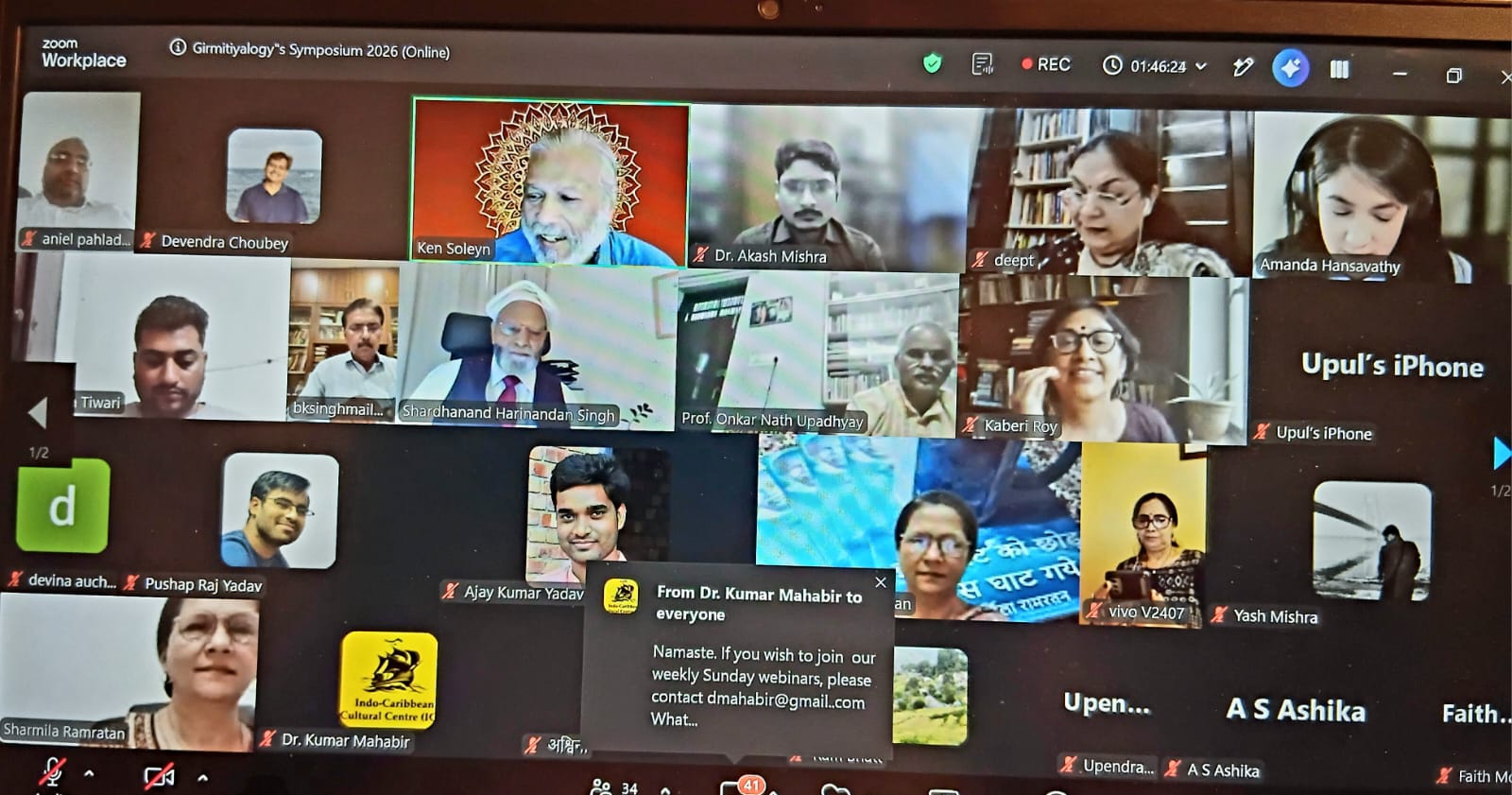
The three-day online international symposium on Girmitiyalogy — jointly organised by GIGA (the Netherlands) and JNU (India), 10–12 September 2026 — brought sustained academic attention to the Girmitiya experience and adopted a proposal for the further development of Girmitiya studies.
The migration of indentured labourers from India during the nineteenth and twentieth centuries gave rise to new economic and cultural phenomena. It was the history of the struggle of the Girmitiya community, which, after migrating beyond the boundaries of India, resisted colonialism and imperialism and, in the process, created a new identity for India in the world.
These significant observations emerged during the three-day online international symposium on “Girmitiyalogy: Text, Theory and Literature,” jointly organised by the Indian Languages Centre, Jawaharlal Nehru University (JNU), India, and Girmitiyalogy Operation, the Netherlands.
The conveners of the online programme — Prof. S. Harinandan Singh, thinker and scholar based in the Netherlands, and Prof. Devendra Choubey, noted writer and Professor at JNU — emphasised that engaging with the theoretical framework of Girmitiyalogy is particularly important in the contemporary world for understanding the processes and consequences of indentured migration. They observed that the world today continues to grapple with the complexities of war, economic inequality, and global expansion, making the study of historical patterns of migration increasingly relevant.
Inaugural Session
The inaugural session featured the Fourth Prof. Manager Pandey Memorial Social Lecture, delivered by Prof. S. Harinandan Singh of the Netherlands on the theoretical foundations of Girmitiyalogy.
Prof. Shobha Shivashankaran, Dean of the Language Institute, and Prof. Sudhir Pratap Singh, Chairperson of the Indian Languages Centre, welcomed the guests and spoke on the central theme of the symposium.
Dr. Kumar Mahabir of the Indian Caribbean Cultural Centre delivered the keynote address. During the session, the guests also released two books authored by Dr. Rashmi Choudhary and Dr. Devendra Choubey: Itihas Ki Sarhaden (Borders of History) and Yah, Vah Desh To Nahin: Mauritius — Ek Samajik Yatra (This Is Not That Country: Mauritius — A Social Journey).
The inaugural session was moderated by Dr. Akash Mishra, while the concluding session was moderated by Dr. Devina Achouyvar of Mauritius.
Four Thematic Sessions
In addition to the inaugural and concluding sessions, four thematic sessions focusing on various dimensions of migration were organised under the themes of Experience, Analysis, Theory, and Philosophy.
Scholars and writers from different parts of the world — including Suriname, the Netherlands, the United States, England, Mauritius, Trinidad and Tobago, and other countries — participated in the symposium.
The participants included Anil Pahladsingh, Shalima Muhammad, Mrityunjay Kumar Singh, Rashmi Choudhary, Lenroy Thomas, Primnath Guptar, Devina Akshayvar, Niket Singh Arvindsingh, Kenyard Solien, Ghanshyam, Ramprasad Bhatt, Ajay Dubey, Akash Mishra, Muhammad Keshavji, Kumar Mahabir, Vidya Parbati Gangadin, Jayachandran R., Ashish Agnihotri, Ravi Prakash Singh, Omkar Nath Upadhyay, Amanda Hansweti, Kaveri Chattopadhyay Roy, Deepti Agrawal, Binod Kumar Singh, Ajay Kumar Yadav, Priyanka Kumari, Abhishek Pandey, Ganeshilal, Dhiresh Tiwari, Pushparaj Yadav, Divya Prakash, and several other scholars and researchers.
The discussions highlighted a wide range of concerns and contexts relevant to the formation and development of Girmitiya studies. These included memory; cultural and economic displacement; methodologies for studying the processes of destruction and reconstruction of civilisations; fragmented pasts; geographical and social displacement; language; literature; music; archival records; cultural identity; and the search for ancestors and ancestral roots.
The speakers emphasised that these diverse dimensions provide important conceptual and methodological resources for understanding the experiences of the Girmitiya community and for developing a broader theoretical framework for Girmitiya studies.
The concept of Girmitiyalogy, developed by Prof. S. Harinandan Singh, was widely acknowledged by the participants as an important theoretical framework for understanding the Girmitiya community, its historical experiences, and its literary and cultural texts.
Academic Significance
The symposium was particularly significant because it brought sustained academic attention to the Girmitiya experience — an area that has not always received adequate representation within mainstream academic discourse.
The three-day deliberations provided an interdisciplinary platform for examining indentured migration not merely as a historical phenomenon but also as a complex process involving identity, memory, displacement, cultural transformation, language, literature, economic conditions, and the reconstruction of individual and collective histories.
The discussions also demonstrated the need for sustained international collaboration and further research in the field of Girmitiya studies. At the conclusion of the symposium, the participating scholars and researchers adopted a proposal for the promotion, expansion, and further development of Girmitiya studies.
The symposium thus emerged as an important academic initiative towards bringing the history, memory, literature, culture, and intellectual legacy of the Girmitiya community into wider scholarly discourse.
Notes
- Report: Dr. Ajay Kumar Yadav, Delhi — with Arvinsingh Niketsingh (Mauritius) and Divya Prakash (Betul, Madhya Pradesh).
Published in the BrainGain College Girmitiyalogy library. Back to all papers →