The New Science of Girmitiyalogy
A call to reformulate our international Girmitiyan identity
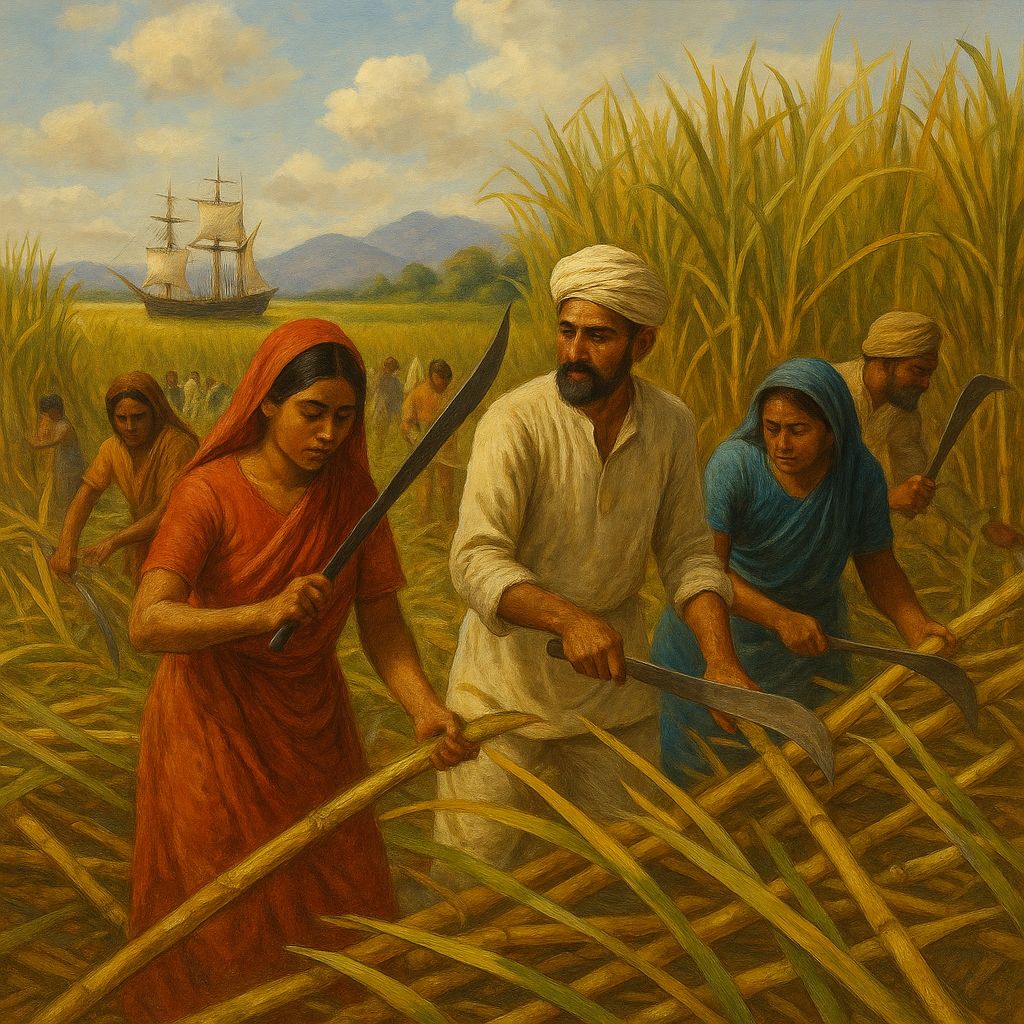
Presented at the BHU conference of 8–10 December 2025: an argument that the Girmitiyas and their descendants are not simply part of the 'Indian diaspora', but a distinct global community whose identity, archives, and education demand a discipline of their own.
Abstract
This essay sketches the contemporary contours of Indian diaspora studies with a special focus on the Girmitiya (indentured) experience and its afterlives. It argues that a field-sensitive synthesis — here termed Girmitiyalogy — integrates archival recovery, transnational social history, the digitisation of Girmitiyan archives, and policy analysis. Drawing on classic scholarship and recent data on migration, it outlines how historical displacement under indenture continues to shape identities, economies, and knowledge production across continents.
The need to redefine our collective and international identity is growing. Are we still an Indian diaspora, and for how long? Are we Overseas Citizens of India (OCI), who are not full citizens but hold extensive rights in the land of our ancestors? Or are we the descendants of Indian indentured servants (Girmitiyas) who settled permanently in the colonies of indenture — where every such community now holds its own, different citizenship? This is a genuine dilemma with a profound bearing on citizenship and identity, and it belongs squarely to the interdisciplinary study of Girmitiyalogy.
Educational curricula
The curriculum for the Executive PhD and the inclusive Minor is now available, and any university may adopt these programs. Professors and lecturers are available, for a reasonable fee, to support and guide their adoption and implementation. The European Institute of Management & Technology (EIMT) has already begun registering PhD candidates for thesis supervision in Girmitiyalogy as a pilot project, with two candidates enrolled; a master's program is in preparation. The focus includes working people who wish to take these courses as second-chance education, and the courses carry international acceptance. Through the inclusive Minor, any MA student may choose Girmitiyalogy as an elective at their own university for the required number of credits, while workers may participate online. The aim is to equip students and professionals — doctors, psychologists, educators, social workers, and policymakers — who engage with communities of Girmitiya origin in their work.
Mission and vision: Girmitiyas and the Indian diaspora
A further concern is the Eurocentric word ‘diaspora’. In the Indian case, a crucial distinction is that indentured migration after abolition was both legally contractual and coercively structured. The field-sensitive term Girmitiyalogy centres the documentary, social, and affective worlds of the Girmitiyas and their descendants, linking empirical archive-work to living memory, public history, and digital repatriation. We hold that the Girmitiyas worldwide clearly distinguish themselves from the rest of the Indian diaspora. Out of necessity on both sides, recruiters and contract workers ended up outside India to take over the work of enslaved Africans, albeit for meagre wages; and these are citizens who do not hold Indian citizenship. In other cases of the Indian diaspora, both characteristics are absent. Our mission is to restore the elements that connect the Girmitiya communities to their land of ancestral origin, and to help reformulate their national and international group identities. There is a cry for such a reformulation: all Girmitiyas hold their own nationality, but share the same nature — Hindustani, or Bharata, in character. I myself am a Sarnami-Hindustani Dutchman.
Girmitiyalogy: concept, origins, and institutional necessity
Girmitiyalogy may be defined as the systematic, interdisciplinary study of the global histories, cultures, and identities of the descendants of Indian indentured labourers, commonly known as Girmitiyas. As a scholarly field it brings together archival studies, oral history, digital humanities, sociology, and cultural anthropology, among other social sciences. Its aim is to decolonise existing narratives and to restore dignity, memory, and continuity to communities historically fragmented by colonial displacement.
The term Girmitiyalogy was first coined and introduced in 2025 by Professor Dr Shardhanand Harinandan Singh, drawing on the colloquial word girmit — a corruption of “agreement” used by the indentured labourers themselves — merged with the Greek suffix -logy (“study of”). The new discipline affirms that the experiences of the Girmitiyas warrant a dedicated field of research, equal in standing to established disciplines such as Indology, sociology, psychology, and anthropology. Its inception coincided with the centennial commemorations of indenture arrivals in Suriname and the Caribbean, and it has since gained traction in academic and cultural fora across India, Western Europe, the Americas, the Caribbean, Mauritius, Fiji, and beyond.
The urgent necessity of Girmitiyalogy
The urgency of Girmitiyalogy lies in its ability to address several gaps:
- Although indenture involved more than 1.3 million people across many continents, their descendants remain under-represented in mainstream scholarship and public history.
- Existing archives are scattered and often inaccessible, demanding a coordinated effort of digitisation and of rewriting history as Itihāsa (the production of truth).
- The psychosocial consequences of forced migration, broken kinship lines, and hybrid identities require specialised frameworks that neither postcolonial studies nor migration theory has adequately provided.
- By foregrounding these aspects, Girmitiyalogy responds to a long-suppressed history — beginning with the repair of individual and collective identity.
Distinctiveness within the Indian diaspora
While the Indian diaspora is often studied as a single global category, the descendants of the Girmitiyas constitute a distinct subgroup whose historical experiences and cultural trajectories differ fundamentally from those of Indians who emigrated voluntarily in the twentieth and twenty-first centuries. The word ‘diaspora’ derives from a Eurocentric idea of people who live outside their country of origin in the expectation that they will one day return home. To me, applying it here is a form of marginalisation and exclusion — of citizens who are fully and consciously integrated into the very countries that Europeans once colonised.
Several characteristics set them apart. First, national belonging beyond India: unlike recent migrants who retain Indian citizenship, Girmitiya descendants were born into societies where indenture had severed juridical and civic ties with the homeland. They hold non-Indian nationalities — Surinamese, Trinidadian, Guyanese, Fijian, South African, Mauritian, and others — and have developed political loyalties to their post-colonial nations of residence. This makes their status qualitatively different from that of Non-Resident Indians (NRIs) or Persons of Indian Origin (PIOs). Second, the absence of homesickness for the homeland: for these descendants, ‘return’ to India is neither a practical aspiration nor a defining sentiment; over many generations they have forged stable identities in their host nations. Third, hybrid identity formation; fourth, enduring cultural and biological bonds with Bharata; and fifth, persistent social challenges.
Hybrid identity
The Girmitiya experience has produced identities that are neither replicas of Indian cultural forms nor simple assimilations into host societies. This “hybrid naturality” is expressed in language, religion, cuisine, music, and social custom, blending inherited elements with those of other ethnic groups. Such hybridity is not a deficiency but a generative cultural resource and an inspiration for future intercultural coexistence. Despite their differences, Girmitiya descendants remain connected to the wider Indian diaspora through deep biological, cultural, and spiritual links with Bharata; shared religious traditions, festivals, and symbols ensure that India remains a point of reference, even where it is not a political homeland. It has also been established that Bollywood productions have had a strong influence on the formation of this hybrid identity worldwide.
The role of Girmitiyalogy
The emerging discipline undertakes the digitisation of documents, the analysis of Girmitiyan history and archives, and the study of these dynamics from a contemporary perspective. Its mission is to study the distinct identity formations of Girmitiya descendants across generations; to report on discriminatory practices within intra-diasporic relations, including linguistic prejudice; to highlight the cultural creativity and resilience of Girmitiya communities as models of hybrid belonging; to build comparative frameworks showing how the Girmitiyas are both unique and integral to broader Indian culture; and to treat as equal the matters concerning indentured labour and the existence of the descendants as full citizens of the nations to which they have belonged for more than 150 years. In doing so, Girmitiyalogy positions itself not only as an academic field but as an ethical project: to restore dignity, equal recognition, and intercultural respect to a community whose voice has too often been marginalised.
Scales and flows: a global cartography
Between the 1830s and the early twentieth century, indenture transported Indians to plantation economies across the British, French, and Dutch empires. A robust scholarly consensus places the overall flow at over 1.3 million persons between 1836 and 1916, with 60,945 arriving in Fiji alone between 1879 and 1916; an estimated 500,000 Indians were shipped to the Caribbean between 1838 and 1917. These figures matter not simply as numbers but as social facts that seeded durable diasporic societies from Mauritius and South Africa to Suriname, Trinidad, and Guyana. Diasporic identities are neither mere survivals of homeland cultures nor simple assimilations; they are negotiated in schools, labour markets, and popular culture — through music, fashion, and media that translate South Asian references into new idioms.
Gendered archives and the ethics of memory
Gendered experience — recruitment vulnerabilities, shipboard risks, plantation labour, and domestic burdens — remains central to the Girmitiya story. Micro-histories recover women's voices and the social complexities of family life under indenture. The widely cited cases of Kunti, Maharani, and Tetary, for example, became touchstones for debating the ethics of female emigration and the responsibility of the state. Reading such episodes alongside plantation records and oral histories adds moral depth to policy discussions today, and raises a pointed question: do we also have the right to demand apology and reparation from the relevant European authorities who, as heirs, bear responsibility for the violent crimes and structural breaches of labour contracts committed under post-slavery colonialism? Opinions remain divided, and those authorities are not eager to countenance any form of compensation.
Conclusion and recommendations
A century after indenture ended, the histories and futures of the Indian indentured communities are entwined. Studying these global communities through the lens of Girmitiyalogy clarifies how archives, communities, and policymakers can work together to recover historical truth while enabling new forms of connection — genealogical, educational, and economic. For universities and cultural institutions this calls for sustained partnerships: opening collections, training young researchers, and building interoperable digital platforms so that scattered records can converge into shared knowledge. Both the Indian government and the governments of the formerly colonised nations should be encouraged to raise awareness of the history of the indentured labourers, who receive too little policy attention compared with communities of African origin. If we wish to gain respect and justice for the suffering of our ancestors, and to secure justice for our future generations, we must create awareness — and stand together.
References
- Bahadur, Gaiutra. Coolie Woman: The Odyssey of Indenture. Hurst & Company / University of Chicago Press, 2013.
- Bhagwanbali, Radjinder. Contracten voor Suriname: arbeidsmigratie vanuit Brits-Indië onder het indentured-labour system 1873–1916. PhD thesis, Radboud Universiteit, 1996.
- Bhagwanbali, Radjinder. Tetary: de koppige. Het verzet van Hindoestanen tegen het indentured-labour system in Suriname, 1873–1916. Amrit, 2011.
- Breedveld, Peter. “The Invisible Success of the Dutch Hindus.” Ad Valvas, 14 Jan. 2015.
- Choenni, Chan E. S. Hindostaanse contractarbeiders 1873–1920: van India naar de plantages in Suriname. LM Publishers, 2016.
- Choenni, Chan E. S. History of Hindostani's 1873–2023: India–Suriname–The Netherlands. Sampreshan, 2025. ISBN 9789083345178.
- Fields, K. E. Bollywood and Cultural Identity in the Indian Diaspora. 2007.
- “Fijian Students' Perceptions of Indian Popular Culture.” International Journal, 2025.
- “Girmitiya Literature: A Raga and Saga of Indentured Labour and Diasporic Identity.” ResearchGate, 27 Aug. 2025.
- “Girmitiyas.” Wikipedia. Accessed 2025.
- Gowricharn, Ruben. “Ethnobotany and Animals in the Girmitiya Diaspora: Explorations from the Caribbean.” South Asian Diaspora, vol. 16, no. 2–3, 2024. DOI: 10.1080/19438192.2024.2360307.
- Harinandan Singh, Shardhanand. Homogenization in Multiculturality. Mumbai, 2024.
- Harinandan Singh, Shardhanand. Social Loss Feelings. Rotterdam, 2025.
- “How Bollywood Shapes Diasporic Identities: Consumption and Representations.” Diaspora & Transnational Communities, 14 Dec. 2022.
- Jayaram, N. From Indians in Trinidad to Indo-Trinidadians: The Making of a Girmitiya Diaspora. Springer, 2022.
- Kaur, Manpreet, and Sanjaleen Prasad. “Home, Migration and New Identities – Fijian Girmitiyas.” Fijian Studies, vol. 15, no. 1, 2018.
- Kumar, Ashutosh, and Crispin Bates, eds. Girmitiyas and the Global Indian Diaspora: Origins, Memories, and Identity. Cambridge University Press, 2024.
- Lal, Brij V. Girmitiyas: The Origins of the Fiji Indians. Journal of Pacific History, 1983.
- Lal, Brij V. “Indian Indenture: History and Historiography in a Nutshell.” Journal of Studies in Indentured Legacies, vol. 1, no. 1, 2021.
- Lal, Brij V., ed. Girmitiyas: The Making of Their Memory-Keepers from the Indian Indentured Diaspora. Primus Books, 2023.
- Maira, Sunaina Marr. Desis in the House: Indian American Youth Culture in New York City. Temple University Press, 2002.
- Munro, Doug. “Of Journeys and Transformations: Brij V. Lal and the Study of Girmit.” In Chalo Jahaji, ANU Press, 2000.
- Northrup, David. Indentured Labour in the Age of Imperialism, 1834–1922. Cambridge University Press, 1995.
- Oxford Bibliographies. “Indian Indentured Servitude in the Atlantic World.” 2017.
- Pande, Amba. Indentured and Post-Indentured Experiences of Women in the Indian Diaspora. Springer, 2020.
- Parmar, Gayatri, et al. “Connecting with the Roots: Girmitiya Memoirs.” Kuey, vol. 30, no. 10, 2025.
- Rai, Satish. Girmityalogy essays and lectures. 2024.
- Singh, Dharmendra Kumar. “Girmitiya Literature: A Raga and Saga of Indentured Labour and Diasporic Identity.” Crossroads, vol. 1, no. 1, July 2025.
- “Stories of Girmitiyas: Folklore and the Sociocultural World of Indentured Indians in the Sugar Colonies.” In Girmitiyas and the Global Indian Diaspora, Cambridge University Press, 2024, pp. 69–82.
- The National Archives (UK). “Indian Indentured Labour.” Research guide, 2007.
- “The Agreement and the Girmitiya.” Harvard Law Review, Mar. 2021.
- Tinker, Hugh. A New System of Slavery: The Export of Indian Labour Overseas, 1830–1920. Oxford University Press, 1974.
- UNESCO. Records of the Indian Indentured Labourers, 1845–1917. UNESCO Memory of the World Register, 2020.
- Upadhyay, Onkar Nath, and Shrestha Pandey. “Girmitiya Literature: The Growth and Development of Girmitiya Literature.” The Achievers Journal, vol. 7, no. 4, 2021, pp. 9–13.
- Varma, A. “Girmitiya Lives: Experiences of Dalit Labourers under Indenture.” 2024.
- World Bank. Migration and Development Brief 39. Dec. 2023.
- World Bank. “Remittances Slowed in 2023, Expected to Grow Faster in 2024.” Press Release, 26 June 2024.
Published in the BrainGain College Girmitiyalogy library. Back to all papers →