
Maharani's Misery: Sexual Violence, Silence, and Historical Justice in the Indenture System
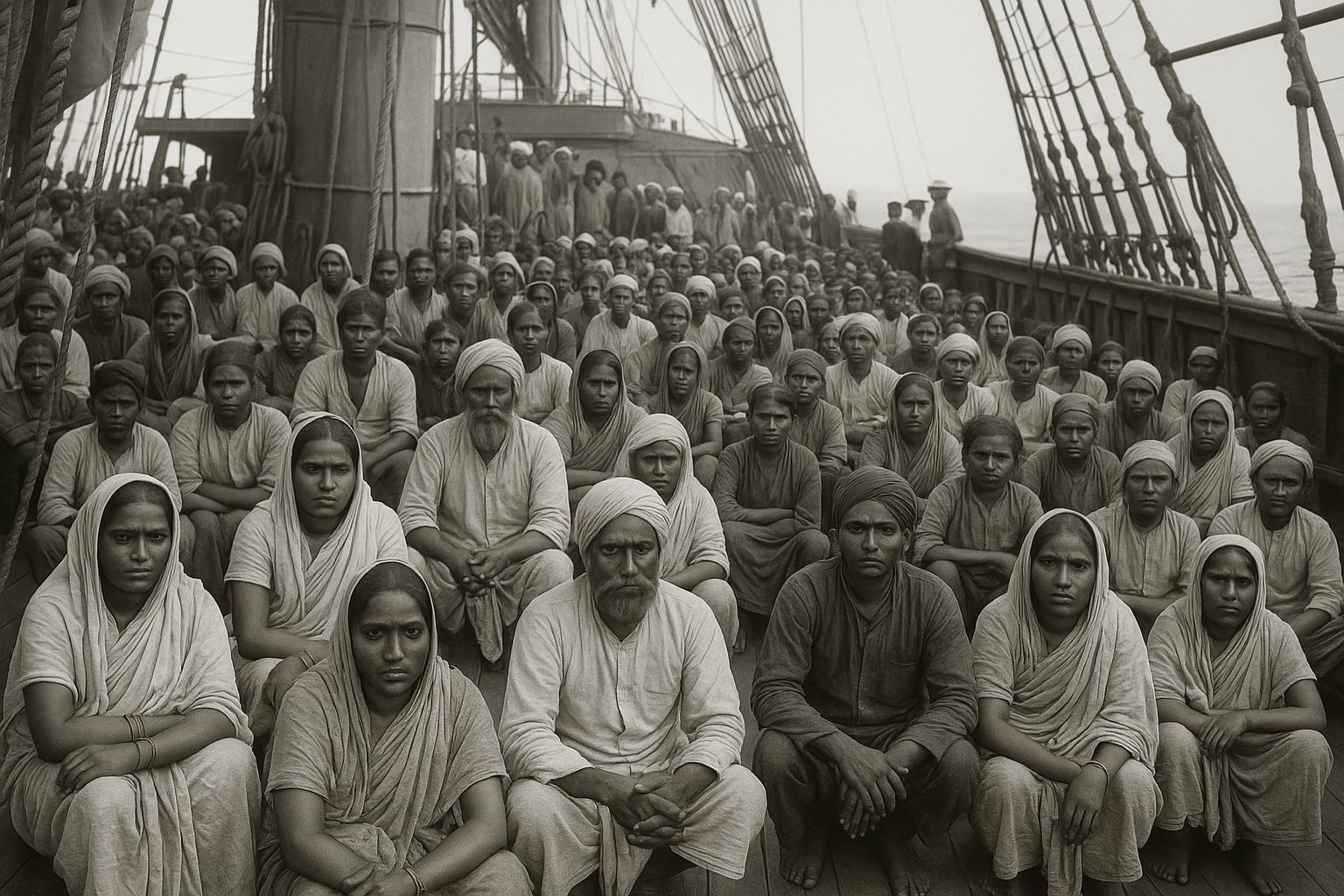
The 1885 death of a young woman aboard the Allanshaw — and the colonial commission that dismissed it — becomes a case study in gendered violence, archival silence, and the argument for recognising indenture as a crime against humanity. This narrative of the colonial past is disturbing.
In the long and painful history of the Indian indenture system, few stories resonate as powerfully as that of Maharani, the young woman whose death aboard the ship Allanshaw in 1885 became a symbol of gendered vulnerability and colonial neglect. Her tragedy, immortalised in Verene A. Shepherd's seminal study Maharani's Misery: Narratives of a Passage from India to the Caribbean, offers a rare window into the lived experiences of women silenced within the machinery of empire. Shepherd recounts that the book “documents the tragedy of a young woman who died on a voyage, reportedly after being sexually assaulted by crew members,” and reproduces testimony from the official 1885 Demerara Commission.
This essay examines the Maharani case not merely as a historical episode but as a legal and moral symbol within the call to recognise indentured labour as a crime against humanity. It argues that the Allanshaw case embodies the intersection of gender, race, and imperial power, where archival silences and testimonial fragments together illuminate the systemic exploitation of women under colonial migration regimes.
1. The narrative of Maharani and the Allanshaw
According to the archival record, the Allanshaw transported Indian indentured workers from Calcutta to British Guiana. During the voyage, Maharani reportedly suffered repeated sexual assault by a crewman named Robert Ipson, after which her health rapidly declined. Captain Frederick Wilson later accused Ipson of violating maritime regulations that prohibited any contact between crew and emigrants. The Demerara Commission of Inquiry, convened in 1885, investigated the incident but concluded that there was “no physical evidence of violence or forced sexual contact” on Maharani's body. Ipson was subsequently convicted only of mutiny and minor theft, not rape. Despite the legal outcome, the case endured in both colonial and post-colonial memory as emblematic of the sexual exploitation of Indian women during indentured migration. Shepherd argues that the story's endurance stems from the contradictions embedded in the colonial archive itself: the records both reveal and conceal the truth, providing enough evidence to acknowledge abuse yet remaining structured to protect the empire's moral legitimacy.
2. Historical foundations and archival evidence
Shepherd's reconstruction relies heavily on the Report of the Demerara Commission (1885), which includes the testimony of the passengers Mohadaya and Moorti, who claimed that Maharani confided in them before dying. According to their statements, she said that “two men held her down while another violated her,” and that “a cloth was forced into her mouth so that she could not cry out.” These harrowing details — echoed in oral retellings among descendants — cannot be conclusively verified through medical evidence. Nonetheless, they illustrate how memory operates as an alternative archive when official justice fails. The autopsy, performed by Dr Edward Hardwicke, cited peritonitis as the cause of death but admitted the absence of any deeper investigation into sexual assault. As Gunning observes, colonial commissions often dismissed claims of violence against women of colour for “lack of evidence,” even when physical examinations were cursory or biased.
This pattern reflects a structural injustice inherent in colonial legal frameworks. Under Victorian morality, Indian women on migrant ships were often portrayed as promiscuous or immoral, and their testimony discounted on grounds of racial and gender inferiority. The archive therefore reproduces the very silencing it seeks to document.
3. Interpreting the silences
Shepherd acknowledges that Maharani's Misery is not a pure documentary record but an act of interpretative recovery. Through narrative reconstruction she gives voice to the otherwise silent figure of Maharani, situating her within a wider structure of coercion and vulnerability. Later scholars, such as Amba Pande, argue that this methodological tension — between historical evidence and empathetic interpretation — is central to the study of gendered migration. In Indentured and Post-Indentured Experiences of Women in the Indian Diaspora, Pande emphasises that “absence in the archive does not equate to absence in history.” Such silences instead invite moral imagination and contextual analysis. In this sense, Maharani's Misery exemplifies how feminist historiography transforms fragmented evidence into ethical remembrance: the truth of the case may remain indeterminate, but the injustice it symbolises is undeniable.
4. Power, race, and gender aboard the Allanshaw
The Allanshaw's crew consisted of White officers, African and Asian sailors (Lascars), and approximately 400 Indian passengers. Racial segregation aboard the ship mirrored the caste-like hierarchies of empire. Colonial maritime codes forbade “improper familiarity” between crew and emigrants, particularly between men of colour and Indian women. When breaches occurred, the authorities often interpreted them as violations of order rather than of human dignity. The accusation against Ipson thus functioned less as a moral protest against rape than as a means for Captain Wilson to reassert disciplinary control. In this context the female body became a metaphorical battleground — its suffering both literal and symbolic of the empire's obsession with control. As Ono-George notes, colonial narratives often turned the “female coolie body” into a site of both moral panic and imperial justification; by casting women as either victims or seductresses, the system absolved itself of accountability for structural exploitation.
5. Shame, silence, and the ethics of testimony
According to Shepherd's transcript, Maharani regarded the assault as “a private matter not to be spoken of,” confiding only in two companions before her death. This silence reveals the intersection of cultural shame and patriarchal oppression: in nineteenth-century Indian society, chastity defined female honour, and to speak of sexual violation was to risk social death. This enforced silence extended beyond the individual to the collective. Thousands of indentured women endured similar abuses but lacked any access to legal recourse or a sympathetic hearing; their stories survived only through whispers, oral traditions, and fragments in colonial ledgers. For contemporary historians and human-rights advocates, such silence demands a response — not only of empathy but of institutional redress.
6. From individual tragedy to structural crime
The Maharani case embodies the argument that indentureship was not merely exploitative labour but a regime of coerced domination. Scholars such as Brinsley Samaroo and Gaiutra Bahadur demonstrate that the system reproduced many of the conditions of slavery, particularly in its treatment of women. Sexual coercion, economic bondage, and racialised violence were integral to its operation. To classify indentured labour as a crime against humanity is therefore not rhetorical but juridically defensible; it aligns with evolving definitions in international law that encompass systematic dehumanisation and sexual violence as crimes transcending temporal limitation. Maharani's death, though officially dismissed as medical misfortune, becomes a juridical metaphor for the countless unacknowledged violations committed under colonial migration regimes.
7. Historical justice and the future of memory
Maharani's Misery invites contemporary readers to confront the moral foundations of historical justice. To read the case merely as tragedy is to lose its deeper significance: it is a call to decolonise not only archives but also the frameworks through which legality and humanity are defined. The story compels the nations once bound by empire — Britain, India, and the Caribbean — to reassess their shared history of coerced migration. For legal advocates and historians, Maharani symbolises both a wound and a warning: a reminder that silence in the face of injustice perpetuates the crime. By transforming archival fragments into collective memory, the historian performs an act of restorative justice.
Summary
Maharani's Misery reveals the brutal gendered violence within the British colonial indenture system. The 1885 death of Maharani aboard the Allanshaw, following sexual assault by a crew member, exposes the silenced suffering of Indian women exploited under empire. Verene Shepherd's reconstruction, based on the Demerara Commission Report, transforms fragmented archives into moral testimony. Through the intersecting themes of race, gender, and power, Maharani's story becomes emblematic of systemic colonial abuse and of the need to recognise indentureship as a crime against humanity. Her silence endures as both historical evidence and a call for restorative justice and remembrance.
Notes
- Maharani — young Indian woman aboard the Allanshaw, 1885 (Shepherd xv).
- Indentured labour — contractual labour system relocating Indians to the colonies (1834–1920).
- Shepherd, Maharani's Misery, Preface xvii.
- Gunning, Sandra. “Beyond Freedom.” Yale GLC Papers 3.
- Report of the Demerara Commission (Public Record Office, 1885).
- Ibid.
- Shepherd, Introduction xxviii.
- Ibid. xxx.
- Shepherd, Appendix B 71–73.
- Shepherd, Appendix C 84.
- Gunning 4.
- Mishra, Violence, Resilience and the Coolie Identity 59.
- Shepherd, Introduction xxii.
- Pande, Indentured and Post-Indentured Experiences 47.
- Lascars — Asian seamen in British service.
- Report of the Demerara Commission, Article 7.
- Gunning 4.
- Ono-George 113.
- Shepherd, Appendix B 72.
- Ibid. 73.
- Pande 50.
- United Nations, Gender-Based Violence and Migration (2020).
References
- Bahadur, Gaiutra. Coolie Woman: The Odyssey of Indenture. University of Chicago Press, 2013.
- Gunning, Sandra. Beyond Freedom: The Impact of the British Emancipation Act on Women in the Caribbean. Yale Global Labour and Colonial Papers, no. 3, Yale University, 2018.
- Mishra, Vijay. Violence, Resilience and the Coolie Identity: Diasporic Trauma and Cultural Memory. Routledge, 2019.
- Ono-George, Meleisa. “Gender, Violence and Colonial Law: Racialised Bodies and Justice in the Caribbean.” Journal of Colonial and Postcolonial History, vol. 12, no. 2, 2020, pp. 105–123.
- Pande, Rekha. Indentured and Post-Indentured Experiences: Women in the Indian Diaspora. Cambridge Scholars Publishing, 2018.
- Report of the Demerara Commission. Public Record Office, London, 1885.
- Shepherd, Verene A. Maharani's Misery: Narratives of a Passage from India to the Caribbean. University of the West Indies Press, 2002.
- United Nations. Gender-Based Violence and Migration: Policy Brief. United Nations Office on Drugs and Crime (UNODC), 2020.
Published in the BrainGain College Girmitiyalogy library. Back to all papers →