Starting to Investigate Migration History, Family History, and the Role of Oral Tradition
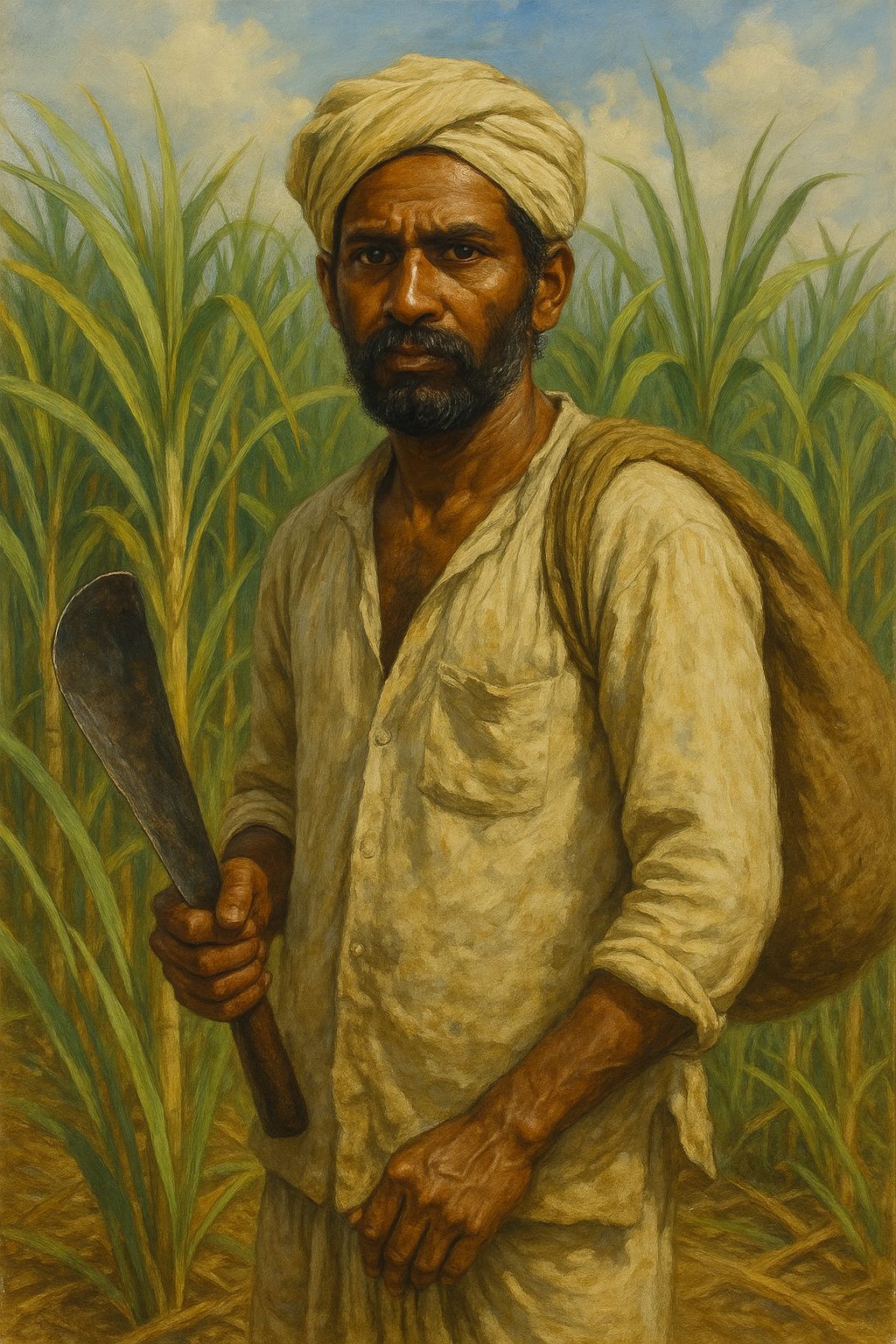
A descendant of Girmitiyas turns to oral tradition and the idea of the 'family soul' to understand the shoulders she stands on — beginning with a live interview of her grandmother, born in Nickerie.
My search for insight and healing
Over the years I have undergone several personal paradigm shifts, including the transition from business administration (my academic field) to public administration (my professional field). I have served democracy and the citizens of Amsterdam, advocating strongly for the accessibility and availability of services and facilities for all. I am a proud descendant of Girmitiyas, and I have always wondered whose shoulders I truly stand on. I ask myself which talents and competencies I have inherited from my ancestors — and which intergenerational wounds and patterns still cause me to suffer today. What can I learn from all of this?
The family soul — Palwaar ke Dil
In finding my way in Dutch society and learning to express myself, I have always sought models and tools that would help me understand my situation and discover my own strengths. Through my professional network I was drawn to the book De Familieziel by Kitlyn Tjin A Djie and Irene Zwaan. Kitlyn is a descendant of the Chinese community of the former Dutch colony of Indonesia. Working in the Dutch youth-care system, she observed that the system defined the core family unit as father, mother, and children (Tjin A Djie & Zwaan, 2013, p. 9). When there was trouble, the child was removed from the family and placed into care. To her this seemed very strange. In her experience of Suriname, many people shape a child's upbringing — grandparents, aunts, uncles, neighbours, and hand-picked kin among them. She therefore developed a more encompassing model for understanding family systems.
She went further still. She found that every family carries particular behaviours and patterns which family members (sub)consciously recognise in their children (Tjin A Djie & Zwaan, 2013, p. 125). Not everything can be found in a person's character; much is to be found in the family's history. In her book she describes oral-history techniques for uncovering these behaviours and patterns, so that one can look for solutions and healing.
More importantly, she points out that migration is one of the most severe events that can occur in a person's life, and that each generation deals with it differently. The first generation — the first to live in a new place — works things out and makes them happen. The second generation shows loyalty to that achievement. The third generation, by contrast, wonders why things are the way they are (Tjin A Djie & Zwaan, 2013, pp. 20, 23). They question everything, and in doing so they give oxygen to the family system. Sadly, this benefit has often gone unrecognised. Here, too, oral-tradition techniques can help.
My starting position
Reflecting on the line of thought offered by Tjin A Djie and Zwaan in De Familieziel, I recognise in myself the behaviour of the third generation. I question many things and feel a strong need to understand and to contribute to the greater good — for the Girmitiya samaaj.
The first steps
At the very first international meet-and-greet on Girmitiyalogy, held on 5 July 2025 in Zoetermeer, the Netherlands, I began my search by conducting a short live interview with my dear choti nani (maternal grandmother). In the Netherlands there is a custom of giving nicknames to the many nanas, ajas, nanis, and ajis in order to tell them apart, though we have no such names for great-aunts and great-uncles. My choti nani is the daughter of a Girmitiya and the youngest phua (paternal aunt) of my mother.
I asked her to introduce herself; to tell us what she knew of her father crossing the ocean — the kala pani — twice, and why; what she remembered of her upbringing, her family life, and the values she was given; which values her father explicitly taught her; and which customs and habits she inferred from the way her parents handled situations.
She answered: “My name is Urmila Baldewpersad Tewarie. I come from Suriname; I was born in Nickerie. My father crossed the kala pani twice. The first time he came with my grandparents from India to the West Indies — first to Guyana, then to Nickerie, and on to Kwatta near Paramaribo. They had a very difficult time. They wanted to build a future, so they returned to Nickerie to work in agriculture. When my father was about seventeen, my grandparents took him back to India. They stayed two or three years, but he could not adapt to life there; he was used to the freedom of Suriname and Guyana. So he left and came back via England, where he worked in London for a year or two, before returning to Guyana, then Nickerie, and later Paramaribo. There he married my mother. Two sons were born in Leiding — one of them your nana, Aartie. Eventually my parents returned to Nickerie, where the last five children, including me, were born.”
She continued: “First of all, we had to learn Hindi. We had to wake at five o'clock and learn Hindi from my father — what to learn, what to write, what to do — before he performed his pooja. Afterwards, around six, he would say, ‘Now you can do your homework in Dutch.’ My brother Hari was a little lazy; when my father went to do his pooja, Hari would push two chairs together and go back to sleep — but he was caught. We always had to be very polite: never simply ‘ha’, but ‘ji ha’, and ‘ji na’ — always two words. I learned how a girl was expected to behave and how to speak with people. Once we started primary school my father relaxed his insistence on Hindi, because he knew we needed Dutch more. As we grew up we became a little westernised. After completing MULO I went to Paramaribo to study further, and there I lost some habits and traditions. I was not as strict with my own children; I was more pragmatic — more western. Mastering Dutch properly mattered, especially when we moved to the Netherlands.”
In this short interview I learned new things about my family that I had not expected. It has made me very enthusiastic to learn more — both about techniques of oral tradition and about my own family. To be continued.
About the author
Aartie Mahesh MSc was born in 1974 and raised in The Hague. She holds a master's degree in economics and studied policy at the Academy for Public Policy and Administration. She is married to Charles Soria and lives in Amsterdam, where she is employed by the Municipality of Amsterdam, working on social-innovation initiatives that improve quality of life and strengthen democratic resilience. Her maternal ancestors originated from Agra; both her parents were born and raised in Suriname and migrated to the Netherlands a few years before Suriname's independence. On arrival in Suriname, many surnames were changed — some by the colonial administrators, some by the individuals themselves. Her surname, Mahesh, was registered as a family name by an administrator, although in India it is a given name.
References
- Tjin A Djie, K., & Zwaan, I. (2013). De familieziel: Hoe je geschiedenis je kan helpen op je levenspad. Prometheus–Bert Bakker.
Published in the BrainGain College Girmitiyalogy library. Back to all papers →